How can a childhood memory become a world you can feel?
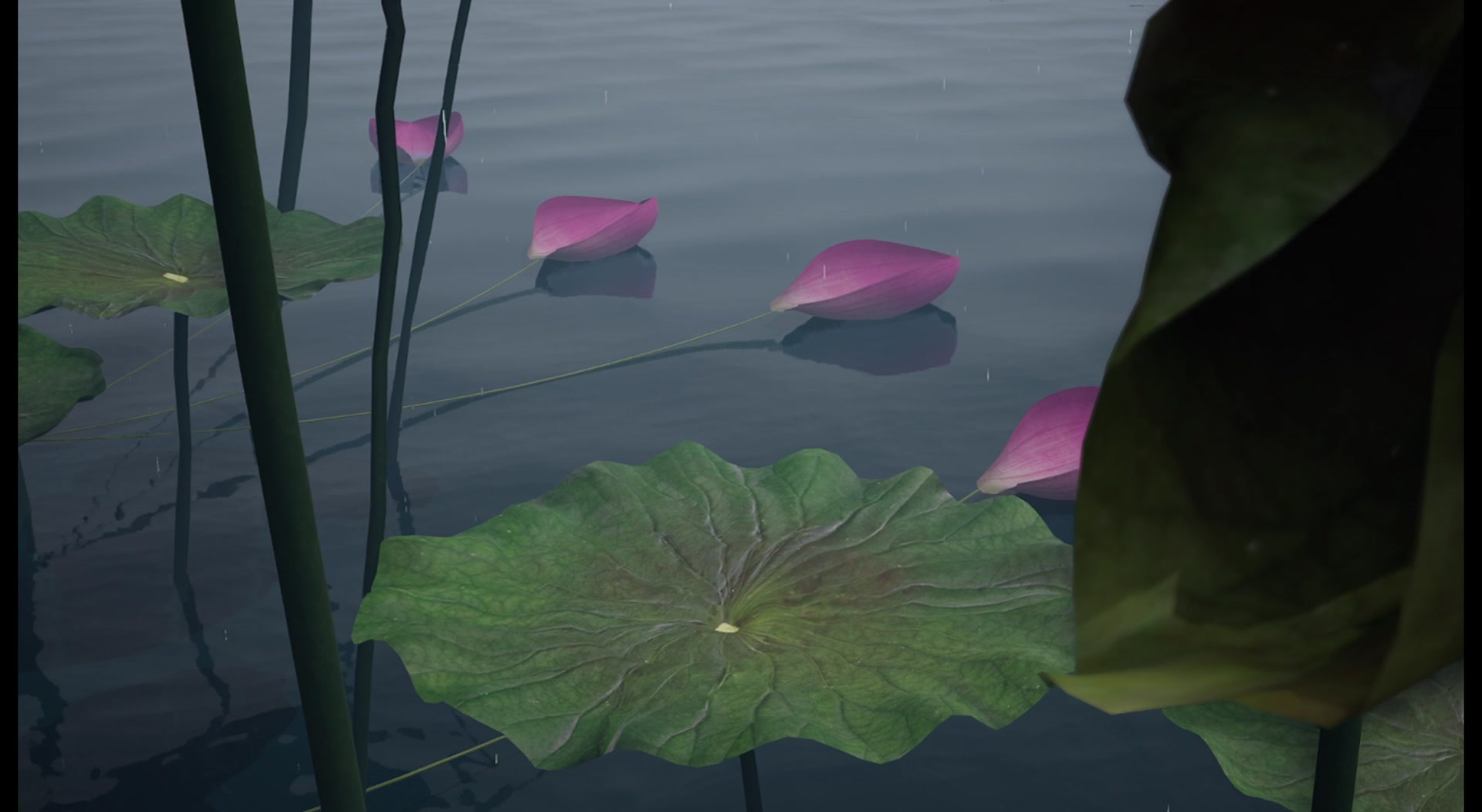
As a child, I imagined my bedroom as a boat cabin. The flowers and water on my curtains became a landscape outside, making sleeping alone feel safe. The Ferry grows from that memory into a world of giant lotuses, floating petals and quiet passages.
I developed the environment in Blender and Unreal Engine, moving from hand-drawn storyboards to a cinematic journey. Scale, enclosure and movement carry the experience: the familiarity of a room gives way to the shelter of a lotus canopy.
Role
Experience Designer
Skills
Worldbuilding, 3D modelling & cinematic storytelling
Time
2025
Tools
Blender · Unreal Engine
The Film
A journey from a familiar interior, across open water and through a sheltered world beneath the leaves.
The Ferry · 3:31 · Sound onFinal film, 2025
Origins
The starting point was a feeling of security. A boat offered both an interior to retreat into and a changing view outside. The idea of ferrying in Siddhartha shifted my attention toward the journey; an oversized lotus canopy offered a threshold between shelter and open water.
A napThe roomThe ferryThe pondThe snapThe farewell
Early storyboard studies. Familiar rooms, water and plant life establish the journey before the environment is built.
World Building
From a cabin to a petal
The first drawings imagined a literal cabin on a boat. As the world developed, the room remained an intimate opening while individual petals became vessels. The lotus could now provide both the shelter overhead and the means of moving through it.
Building the lotus forms in BlenderPetals become vessels
A room that feels remembered
I built the interior around the bed, desk and window, using domestic references to guide its proportions and objects. Lighting and familiar details make this the emotional starting point; the window introduces the larger world before the camera enters it.
Early interior model · MarchThe room in the final film
Shaping the passage
The March environment used craggy, more realistic rock formations. By April, I was exploring faceted mountains and moss materials. These simpler forms frame the water route while the lotus canopy becomes the main spatial presence.
March · rocky canyon studyFinal · faceted landscape
View layout and material studies +
An early route sketchTesting the landscape from aboveDeveloping the moss materialModelling the leaf surface
Motion & Atmosphere
Once the world took shape, I developed how it would move and feel. Weather, swaying plants, ropes, buoyancy and camera animation bring the environment to life at different scales.
Let the distance dissolve
Early lighting made the scene bright and exposed. Fog softened the horizon and separated layers of stems, leaves and cliffs; rain brought movement into the air. The result is a space that reveals itself gradually as the camera travels.
Early lighting studyTesting fog and depth
View the rain setup +Rain system study
Give the world weight and rhythm
Buoyancy tests let the petals respond to the water, while a wind-driven material gives the lotus leaves a gentle sway. Rope studies explored how petals could remain connected to the plants. These small movements make the stillness feel alive.
Petal buoyancy · development testLotus movement · environment test
View the motion setup +
Buoyancy component and support pointsWind-driven leaf materialTesting the tetherCamera and floating viewpoint
Make the camera part of the journey
I tested camera shake and floating viewpoints alongside the petal motion. The final sequence moves between intimate interior views, the scale of the canopy and narrow passages, before opening into a larger grove. The changing viewpoint carries the sense of drifting through the world.
Travelling through the passage · final film excerpt
The final poster
A shelter without walls
The final poster looks up from the water, letting the lotus leaves fill the sky. It brings the same idea of shelter into a single image.